Meeting Accreditation
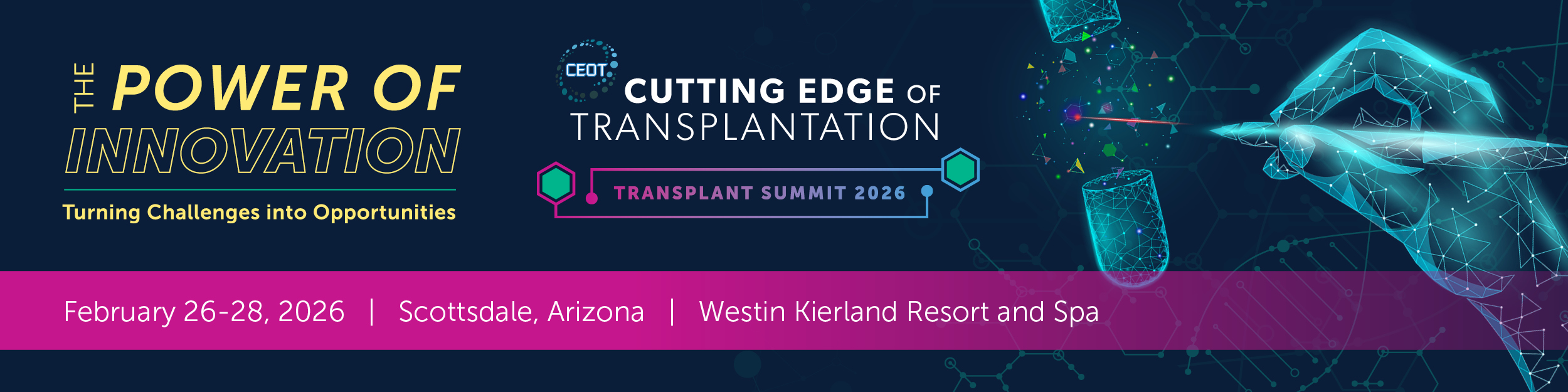
Cutting Edge of Transplantation Transplant Summit 2026
The Power of Innovation: Turning Challenges into Opportunities
February 26 – February 28, 2026
Westin Kierland Hotel
Scottsdale, AZ
This activity is jointly provided by Global Education Group (Global) and American Society of Transplantation.
This activity is supported by educational grants from Takeda Pharmaceuticals U.S.A, Inc., United Therapeutics Corporation and Veloxis Pharmaceuticals, Inc. and in part by educational grants from Apellis Pharmaceuticals, Inc. and Bristol Myers Squibb.
Program Description and Learning Objectives
Target Audience
The target audience for Cutting Edge of Transplantation (CEoT) 2026 includes clinicians such as physicians, nurses, nurse practitioners, physician associates, and allied healthcare practitioners. The target audience also includes scientists, trainees, organ donation professionals, and patients in the field of solid organ transplantation and donation interested in the pragmatic and practical aspects of transplantation.
Statement of Need/Program Overview
The CEoT meeting brings together clinical and translational experts from the fields of chronic disease, end-stage organ disease, and solid organ transplantation. This interactive forum is designed to deepen understanding of advances in clinical transplantation and regulatory policies that impact transplantation, while also providing solutions and tools to integrate these advances into clinical practice.
Recent policy changes have significantly impacted the organ transplant and donation ecosystem, including the HRSA OPTN Modernization Initiative, cuts in research funding for transplantation science, and disruption of the integrated networks that support transplantation, such as downsizing at the Centers for Disease Control and HRSA. The overarching goal of CEoT 2026 is to address these challenges and to explore opportunities to continue improving patient care and expanding clinical and research impact.
Overall Conference Learning Objectives:
Following this activity, attendees should be able to:
1. Discuss how relevant policy and funding issues in transplant affect innovation.
2. Review innovative opportunities for funding and research that are both pragmatic and impactful.
3. Identify cutting-edge innovations in the transplant system to enhance the efficiency and effectiveness of organ donation and transplantation.
4. Describe the future of a modern transplant system including how healthcare delivery can be best coordinated, integrated, and supported across the entire system.
CME-Certified Sessions Learning Objectives:
Session 2 Learning Objectives:
Following this session, attendees should be able to:
1. Describe what a surrogate endpoint in a clinical trial is and how it can be used to spur innovation in transplant.
2. List examples of how real-world evidence has been used to obtain FDA approved indication in transplantation and beyond.
3. Discuss how biomarkers can be used to accelerate clinical research by improving the efficiency of trial conduct.
Session 3 Learning Objectives:
Following this session, attendees should be able to:
1. Describe the spectrum of current deceased donor research focused on improving organ recovery and patient outcomes.
2. Review the core regulatory challenges associated with designing clinical trials involving deceased organ donors with a focus on lung donation and transplantation.
3. Describe current innovations in genomics and donor research from perspectives of donor next of kin, clinicians and researchers to advance medicine.
Keynote Address Learning Objectives:
Following this session, attendees should be able to:
1. Define health disparities based on demographic and social constructs within the contemporary U.S. healthcare context based on scientific evidence and population-level data.
2. Evaluate potential evidence-based strategies, including their application, to reduce healthcare disparities with the goal of improving health outcomes across patient populations.
3. Identify how health policies developed and implemented at local, state, and national levels, impact healthcare, patients and communities.
Session 5 Kidney Breakout Learning Objectives:
Following this session, attendees should be able to:
1. Identify challenges and opportunities in sustaining successful transplant centers.
2. Discuss strategies to address workforce shortages in transplantation.
3. List novel approaches to organizing transplant care.
Session 5 Heart Breakout Learning Objectives:
Following this session, attendees should be able to:
1.Describe issues with the current allocation scheme, and how Continuous Distribution may help
2. Identify unforeseen consequences potentially affecting pediatric candidates from changes in pediatric heart or even adult heart or multi-organ allocation
3. Review implications, outcomes, quality, finances – of current and future transport and preservation technology
Session 5 Liver Breakout Learning Objectives:
Following this session, attendees should be able to:
1. Describe recent advances in national liver allocation and how continuous distribution can contribute equitable access to liver transplant care.
2. Identify cost-effective and value-driven center-level considerations related to liver perfusion logistics
3. Discuss clinical implications of on-site vs back to base perfusion initiation protocols
Session 5 Lung Breakout Learning Objectives:
Following this session, attendees should be able to:
1. Describe allocation challenges across the lung transplant system including the perspective from the OPO, transplant centers, and system leaders.
2. Review the impact of the recent allocation change and visualize elements of the next allocation through the lens of continuing to improve equity.
3. Define opportunities for future optimization of allocation challenges.
Session 6 Kidney Breakout Learning Objectives:
Following this session, attendees should be able to:
1. Review the current islet replacement strategies in the management of type 1 DM.
2. Discuss how newer therapies may allow patients with some cancers safer for transplant.
3. Describe the new modalities of desensitization for allowing transplant in highly sensitized kidney transplant candidates.
Session 6 Heart Breakout Learning Objectives:
Following this session, attendees should be able to:
1. Identify gaps in device development pipeline.
2. Describe barriers to candidacy and access.
3. Discuss whether devices can become the destination therapy. If not, how can they buffer demand?
Session 6 Lung Breakout Learning Objectives:
Following this session, attendees should be able to:
1. Examine new therapeutics in advanced lung disease and describe the potential of these therapies to delay or avoid lung transplant in the future.
2. Describe opportunities for expansion of recipient access to transplant by challenging accepted recipient selection practices specifically regarding advanced age, high comorbidity burden, oncologic survivors and frailty.
3. Identify disparities in the referral to transplant process and develop implementable solutions to decrease transplant disparities by 2035.
Session 6 Liver Breakout Learning Objectives:
Following this session, attendees should be able to:
1. Describe how evolving concepts of abundance in organ availability may alter adult liver transplant candidate selection and listing practices.
2. Assess the impact of genomic medicine and changing pediatric liver disease epidemiology on future pediatric transplant candidacy.
3. Evaluate surgical and programmatic considerations that will shape the design of liver transplant waitlists by 2035, including equity, allocation, and institutional capacity.
CME Lunch Symposium #1 - A New Frontier for Co-stimulatory Blockade:
Describe the immune mechanism of co-stimulation
Review the uses benefits and risks of co-stimulatory blockage after transplantation: potential for new patient populations
Describe how co-stimulatory blockade could be utilized in desensitization of patients with high level anti-HLA antibodies
CME Lunch Symposium #2 - Mechanisms and Treatment of Immune Complex GN and C3 GN
1. Describe the mechanistic drivers behind IC GN and C3 GN
2. Discuss the factors predicting outcomes of ICGN and C3GN after transplantation
3. Discuss treatment options for ICGN and C3 GN
Program Agenda/Faculty
Please view the entire program including faculty at the link here.
This activity has been planned and implemented in accordance with the accreditation requirements and policies of the Accreditation Council for Continuing Medical Education (ACCME) through the joint providership of Global Education Group (Global) and American Society of Transplantation. Global is accredited by the ACCME to provide continuing medical education for physicians.
* This CME/CE activity complies with all requirements of the federal Physician Payment Sunshine Act. If a reportable event is associated with this activity, the accredited provider managing the program will provide the appropriate physician data to the Open Payments database.
Physician Credit Designation
Global Education Group designates this live activity for a maximum of 8.5 AMA PRA Category 1 Credits™. Physicians should claim only the credit commensurate with the extent of their participation in the activity.
ABIM MOC Recognition Statement
Successful completion of this CME activity, which includes participation in the evaluation component, enables the participant to earn up to 8.5 medical knowledge MOC points in the American Board of Internal Medicine’s (ABIM) Maintenance of Certification (MOC) program. Participants will earn MOC points equivalent to the amount of CME credits claimed for the activity. It is the CME activity provider’s responsibility to submit participant completion information to ACCME for the purpose of granting ABIM MOC credit.
Nursing Continuing Education
Global Education Group is accredited as a provider of nursing continuing professional development by the American Nurses Credentialing Center's Commission on Accreditation.
This educational activity for 8.5 contact hours is provided by Global Education Group. Nurses should claim only the credit commensurate with the extent of their participation in the activity.

Pharmacist Accreditation Statement
Global Education Group is accredited by the Accreditation Council for Pharmacy Education as a provider of continuing pharmacy education with Commendation.
Credit Designation
Global Education Group designates this continuing education activity for 8.5 contact hour(s) (.85 CEUs) of the Accreditation Council for Pharmacy Education.
This is a knowledge-based activity.
Physician Assistants
AAPA accepts certificates of participation for educational activities certified for AMA PRA Category 1 Credit™ from organizations accredited by ACCME or a recognized state medical society. Physician assistants may receive a maximum of 8.5 hours of Category 1 credit for completing this program.
Instructions to Receive Credit
Following the meeting, all participants will receive a link to an online posttest and evaluation form. After completing the posttest and evaluation, participants may claim a certificate noting the appropriate amount of credit or request a general certificate of attendance.
For pharmacist learners, partial credit may not be awarded, so sessions must be attended in their entirety to claim credit. Participants requesting pharmacy credit must submit requests for credit within 55 days of participation.
Disclosures of Relevant Financial Relationships
Global adheres to the policies and guidelines, including the Standards for Integrity and Independence in Accredited CE, set forth to providers by the Accreditation Council for Continuing Medical Education (ACCME) and all other professional organizations, as applicable, stating those activities where continuing education credits are awarded must be balanced, independent, objective, and scientifically rigorous. All persons in a position to control the content of an accredited continuing education program provided by Global are required to disclose all financial relationships with any ineligible company within the past 24 months to Global. All financial relationships reported are identified as relevant and mitigated by Global in accordance with the Standards for Integrity and Independence in Accredited CE in advance of delivery of the activity to learners. The content of this activity was vetted by Global to assure objectivity and that the activity is free of commercial bias.
Global Contact Information
For information about the accreditation of this program, please contact Global at 303-395-1782 or [email protected].
Americans with Disabilities Act
Event staff will be glad to assist you with any special needs (ie, physical, dietary, etc). Please contact Shelbi Hogan prior to the live event at (208) 515-5322.